Fresh Salsa


Warning: htmlspecialchars_decode() expects parameter 1 to be string, NULL given in /home/content/s/j/p/sjpeer/html/mysquarefootgardennet/wp-includes/compat.php on line 113

I can’t believe I haven’t posted this recipe–it’s our FAVORITE!!! Seriously, I could drink it. When you start eating it, and can’t stop, you’re going to think that someone slipped in a narcotic–it’s so addictive. I got this recipe from my sister, and tweaked it just a little.

Chop to desired consistency (in a food processor or blender) and put in a bowl:

  • 1 Jalapeno pepper (remove seeds and chop very fine–add one or two tomatoes to help give it enough liquid to puree)
  • 2 Anaheim or mild peppers
  • 2 Bell Peppers
  • 3 pounds (about 13 medium) Tomatoes–leave skins on! (if your tomatoes are very juicy, you may want to drain them first)
  • 1 Onion
  • 2 cloves Garlic (pressed)
  • 2 TBS Cilantro

Add spices and seasonings:

  • 1/3 C Vinegar
  • 2 tsp Salt
  • 2 tsp Chili powder
  • 1/2 tsp Oregano

Combine and enjoy right away with chips, sour cream, and guacamole!


Happy gardening!

Harvest Time! (and August update)

I love it when it’s finally time to enjoy the fruits, and vegetables, of my labors!!! Yum!

In my new Easy Garden box I planted 4 squares of green beans, and we’ve been swimming in them! So far I’ve picked about 4 pounds of beans. The trick with green beans is to keep harvesting them, and to pick them before the seeds get big and bulging. The plant thinks it has not yet reached its goal of putting out seeds, and so it keeps trying–producing a bountiful crop!

I have LOVE LOVE LOVED the variety of cucumbers I grew this year! (Burpee double feature hybrid, for those who are wondering). They are great small, medium, and large. So far no bitter cukes, and most are a good shape. Here’s my first picking, but now I go harvest a few more every day. I’m hoping to get enough to do some batches of pickles!

I harvested all my onions, set them out to dry, and then it rained! Fortunately it didn’t last long, and after a week outside these were ready to be weighed and measured! Here you see 6 pounds of red onions, 3 pounds of sweet onions, and 7 1/2 pounds of yellow onions.

I planted 4 squares of carrots, and about half were ready to eat. This is half of that batch (if you do the math–about 1/4 of my total harvest). Some were pretty funky–forked ends, split wide open, etc. But ALL are delicious!

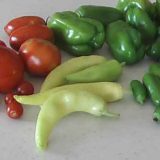
My peppers and tomatoes have only just started to produce ripe fruit, and here is the first little harvest of those.

I never took pictures, but I got THREE HUGE heads of broccoli this year. The extended spring really served me well! However, by the time I harvested it was too hot to grow side shoots of smaller broccoli heads. Maybe next year!

I also harvested lots of sugar snap and snow peas. Again, no photos, but lots of enjoyment for my family! I don’t think I got as many as last year, but plenty for dipping in ranch and snacking on while outside in the backyard.

Finally, I have pulled up all my potato plants, but I left the potatoes in the ground. When we’re ready to have some for dinner I go out (or send my 6 year old) and dig some up. So I probably won’t have an accurate idea of how much I grew, since the harvest will be spread out over the summer and fall.

And a quick update of what my gardens look like:
My cucumbers are quite unruly, and don’t want to grow up the trellis at all. What’s tricky is that they are so scratchy, so I have to have gloves to wind them around the trellis, and I would have to be more diligent to keep all of them going vertical. Next year I’m going to try just tying string, and growing each plant on one string.

All my potato plants were falling over and turning brown, so I pulled them out! The potatoes are still in the ground, but I tried moving my irrigation so they won’t be wet.

Check out those tomatoes–yes, they are growing past the top of that 6-foot fence!

BTW, the Borax worked wonders on the beets! If you look closely you can see the old dead leaves, and the new beautiful healthy leaves!

And here are all the east gardens in one shot. It really lets you see how much the north (left) plants are thriving while the others are just okay. Still need to move those sprinkler heads. . .

I have a few recipes to share–the most delicious potato salad, potatoes-tomatoes-and-mayo (a family favorite), so stay tuned for those!


Happy gardening!

Let me link to you!

Hey, this is for all those who write gardening blogs, or just blog about your garden sometimes. I’m going to create a list of gardening blogs on the Your SFG page. You don’t have to follow the square foot gardening method–you just have to grow stuff and write about it!

If you are interested in having your blog listed on my Your SFG page, send an email to mysquarefootgarden@gmail.com. Be sure to include:

  • Name (first only)
  • Location (city and state/province)
  • Gardening method (traditional, container, raised bed, square foot, etc.)
  • Link to your blog

Of course, it’s great if you link to me too, but so many of you already do that it’s hardly worth mentioning! :)

Happy gardening!

Zucchini and Cornbread

My sister-in-law gave me this great recipe. I’m always looking for a yummy way to eat zucchini–other than bread.

Zucchini and Tomatoes

Combine in a skillet until onions are soft and translucent:
1 TBS olive oil
1 small/medium onion, chopped
1 clove garlic, crushed/minced

Add and cook 2 minutes:
1 small/medium zucchini, sliced

Add and simmer 5-10 minutes:
1 (15oz) can diced tomatoes, with juice
1 (15oz) can black beans, rinsed and drained
1/2 tsp oregano
2 cups of water (use less if you want a thicker sauce)
salt and pepper to taste

Serve over cornbread, top with sour cream.

Corn bread

Combine in a bowl:
1 C flour (I use 1 C whole wheat plus 1/4 C white)
1 C cornmeal
2-4 TBS sugar
1 T baking powder
1/2 tsp salt

Combine in another bowl:
2 eggs
1 C milk
1 tsp lemon juice
1/4 C oil

Mix dry and wet just until batter is smooth. Pour in greased pan (9×9 or medium bread pan) and bake at 425 for 25 minutes.


Happy gardening!

Gardening Problems, Solutions, and Update

I’ve been so busy putting together my new fall planting schedule that I’ve fallen behind on giving garden updates. As I compared the pictures to my last update, I was amazed at how much everything grew, and so quickly. This week I’ll take more pictures and you can see how things are looking today!


Here is my south-west box–from left to right I have cucumbers (on the trellis), onions, carrots, onions, broccoli (in the back), cilantro (going to seed), and lettuce. I am letting the cilantro go to seed, because I tried that last year and had so much fantastic cilantro in the spring! All my plants were small, so I got lots of cilantro before things got too crowded.


PROBLEM: Onions falling over

As you can see, some of my onions started falling over.

SOLUTION: Let them fall

When the onions start tipping over it means it’s getting time to harvest them, so I “helped” the rest. I’ll leave them this way for a week or two, until the tops are brown. That’s when I harvest them, and then let them dry for a week or two in the sun.


PROBLEM: Too hot for peas, potatoes

This garden box had my peas, but it finally got too hot for them to grow. If you look closely you can see my dead pea plants on the ground right in front of this garden bed! What’s left is potatoes.

SOLUTION: Leave the peas for shade

In retrospect, I should have left the peas in the ground. They gave the potato plants some shade, and as soon as I removed them the potatoes started falling over. Next year I’ll know better!


Here is my new Easy Garden box, and things are flourishing! On the left are beets (see below), then tomatoes and green beans. I also had some Mother’s day flowers that I planted, and they spread and multiplied a ton! The left corner that is empty is where I planted a bunch of herbs–they didn’t do as well. I think I just now have a tiny oregano plant. Well, next year I’ll start those inside!


PROBLEM: Brown beets

Check out my sad, sad beets. Every time I plant beets I have had this type of result, which is discouraging.

SOLUTION: Boron

I did a little research, and beets are relatively unharmed by bugs and disease. The only problem they have is a lack of boron. I bought some Borax and dusted it over the soil. This is supposed to help–I’ll let you know! (BTW, I found the Borax in the laundry section.)


Here is the north-east garden bed with 4 tomato plants. Looking good!


This is my middle-east garden bed. I had a “volunteer” growing in the corner, and I left it to see what would grow (see below).

PROBLEM: Tomato plants not growing well

I have noticed that these tomatoes are not as green, full, and tall as the ones in the north-east bed.

SOLUTION: Move sprinkler head

I realized that my lawn sprinklers water this and the south-east bed, which is actually inhibiting the growth of my tomatoes. So, I need to dig them up, move them, and put on different nozzles. Yep, because I have all sorts of time for projects like that . . .


So the “volunteer” plant is some type of summer squash. But I think it’s from a seed that went into my compost, because the color and shape are different from anything I’ve planted before. In the end I pulled this plant–it was blocking the sun from my tomatoes and the squash was not very good.


And here is my trellised cherry tomato plant, and 12 pepper plants. The tomato needs a little pruning, and the peppers were not thriving.


PROBLEM: Poor pepper plants

My peppers were small, yellow, with dark purple on the leaves. I fertilized them, but did not see much improvement.

SOLUTION: Eggshells

My cousin gave me this simple recipe for feeding tomatoes and peppers, and it WORKED WONDERS on my pepper plants! Last year I did this and fertilized all at once so I couldn’t tell which one was the magic. Now I know–it’s the eggs!

Save your eggshells (I saved mine all winter), let them dry out, and crush them up. Add to water (2 dozen eggshells to 2 quarts water) and let sit overnight. Water the peppers (and tomatoes) with the water, and discard the shells. Within 2 weeks my peppers were growing big, flowering, and producing peppers.


Happy gardening!

How to Prune Tomatoes

If I get a chance, I’ll try to update this post with graphics and written instructions. For now you have to watch me in the video!

Happy gardening!

Announcing: New Fall Planting Schedule!

Drum roll please . . . after much blood, sweat, and tears, I am proud to announce my new Fall Planting Schedule!!!

The newsletter sign up now has room to indicate both your spring and fall colors (which are Maroon, Goldenrod, Olive, Navy, Purple, and Brown).  As part of this round of improvements, I have simplified the process of determining your color and added two new colors to the Spring Planting Schedule (White and Pink).

Here is a list of vegetables included in the Fall Planting Schedule:

  • Beets
  • Broccoli
  • Bush Beans
  • Cabbage
  • Carrots
  • Cauliflower
  • Collards
  • Endive
  • Kale
  • Kohlrabi
  • Lettuce
  • Mustard
  • Peas
  • Radishes
  • Spinach
  • Swiss Chard
  • Turnips

How do I sign up?

If you are already signed up to receive the weekly reminders, I will send you an email with detailed instructions on August 1, 2010. Please check your spam/junk folders if you don’t see it in your Inbox. Contact me at mysquarefootgarden@gmail.com if you don’t receive the email.

If you have not yet signed up to get weekly reminders of when to plant:

  1. Go here to find your color
  2. Sign up in the form on the right sidebar

Want to see it all at once? The Fall Planting Schedule has been added to my Planting By Color e-book. Those who have already purchased the e-book and signed up for updates will automatically receive a link to download the new schedules.

Happy gardening!

Gardening Patterns

Spring-Summer-Fall

The most typical gardening pattern for North America is the Spring-Summer-Fall (S-S-F) gardening season. These gardeners have a spring frost date (the average date of the last spring frost) and a fall frost date (the average date of the first fall frost), and have to fit in all the gardening in between!

S-S-F gardeners plant Hardy vegetables in the spring, followed by Semi-Hardy. After the frost date, they plant Tender and, a few weeks later, Very Tender plants. Soon the temperatures are too warm for the Hardy and Semi-Hardy plants, and they must be harvested or go to seed.

If the growing season is long enough, S-S-F gardeners can plant a second time, for harvesting in the fall. The fall garden generally includes a second planting of Hardy and Semi-Hardy plants. Most of the Tender and Very-Tender plants take a long time from seed to harvest, so they are still growing until the fall frost kills them.

If your growing season is short, you may choose to plant only Tender and Very Tender plants in the spring, and then plant Hardy and Semi-Hardy plants mid-summer for a fall harvest.

Spring and Fall

Some folks live in areas where it is cold to grow in the winter, and very hot in the summer. These areas have a spring frost date (the average date of the last spring frost) and a fall frost date (the average date of the first fall frost), and in between the temperatures soar.

This creates two growing seasons—Spring and Fall (S-F).  In the spring, S-F gardeners should choose bolt-resistant varieties of Hardy and Semi-Hardy veggies that mature more quickly. This will increase your odds of a good harvest before temperatures get too hot.

The good news is, since they live in the South or Southwest, these gardens get lots of sunshine and enjoy mild winters. While most people will only plant Hardy and Semi-Hardy vegetables in the fall, these gardeners can often plant Very Tender and Tender vegetables as well. By choosing varieties that do well in cold weather, S-F gardeners can have success growing Hardy and Semi-Hardy vegetables all winter long!

Often S-F gardeners have a longer time frame for sowing seeds, especially for a fall garden, and winter conditions that allow the hardiest plants to survive. If you are a S-F gardener and follow my Planting By Color schedule, please remember that it outlines the soonest and latest you can plant for spring and fall gardens. You may have more flexibility in when you plant.

Fall-Winter-Spring

Some locations are simply too hot to have a successful garden outdoors during the summer, but they have no fall frost date, or such a short, mild period of potential freezing temperatures that they can grow a garden all winter. Then, they continue gardening in the spring until temperatures get too hot again in the summer. These gardeners have a Fall-Winter-Spring (F-W-S) pattern.

F-W-S gardeners will have success planting Hardy and Semi-Hardy vegetables in the fall, and then planting Tender and Very Tender vegetables in the Spring. Like the S-F gardens, many Hardy and Semi-Hardy plants can be grown later, and possibly all winter long. This means the time to sow plants may be extended as well.

Year-Round Gardening

I envy those gardeners who live in areas without any frost, and climates mild enough to grow a garden all year round! Theoretically, you could plant any vegetable at any time. In practice, certain vegetables will grow better if planted in the right season.

Hardy and Semi-Hardy vegetables will thrive if planted in the fall and grown all winter, into the spring. Tender and Very Tender vegetables should be started in the spring, to grow all summer and harvested in the fall.

You will notice that most seed packets indicate planting date based on frost-date. If you don’t have a frost date, your planting schedule is probably related to the hours and intensity of sunlight you receive and average temperatures. Just because you live in an area without a frost date does not mean that my Planting by Color schedule does not pertain to you. For example, many areas in Northern California have no frost dates, but their planting times are the same as the Orange group.

Happy gardening!

Types of Plants–Very Tender, Tender, Semi-Hardy and Hardy

Plants can be divided into several types depending on how well they tolerate cold, freezing temperatures, and frost.

Very Tender

These types of plants cannot tolerate any frost or cold temperatures at all. They need to be planted when the weather is warm, after all danger of frost has passed.

All of these Very Tender plants have long growing seasons (they take a long time to go from seed to harvest), so you want to wait until the weather is warm enough for them, but you can’t wait too long or you will not have a chance to harvest before hot or cold temperatures set in. They tend to love warmer temperatures, and thrive in the heat.

Almost all of these plants must be transplanted outside. Unless you live in an area that is temperate (no extremely hot or cold temperatures), there is not enough time for them to grow outdoors from seed to harvest. You must either purchase transplants, or grow them yourself indoors, under lights.

  • Cantaloupe and Melons
  • Eggplant
  • Lima Beans
  • Okra
  • Peppers
  • Pumpkins and Winter Squash
  • Tomatoes

Tender

These types of plants can tolerate some cooler temperatures, but frost will kill them. They are generally planted in the ground on the date of the average last spring frost.  They grow best in when it’s warm, but not extremely hot.

  • Celery
  • Cucumber
  • Dry Beans
  • Snap Beans
  • Summer Squash and Zucchini
  • Sweet Corn

Semi-Hardy

These plants thrive in cool temperatures. Some of them can tolerate heat, but many will bolt or go to seed when temperatures rise. These plants are particularly great to grow in temperate areas, or in the spring and fall.

  • Beets
  • Carrots
  • Cauliflower
  • Endive
  • Lettuce
  • Mustard
  • Parsley
  • Parsnip
  • Potatoes
  • Swiss Chard
  • Spinach

Hardy

These plants thrive in cool weather, and will die, bolt, or go to seed when things get hot. They grow well in the spring and fall, and in warmer climates, they can be grown all winter long! In the spring, they can be planted as soon as the soil can be worked (with soil temperatures of 40°F).

  • Asparagus
  • Broccoli
  • Cabbage
  • Kale
  • Kohlrabi
  • Leeks
  • Onions
  • Peas
  • Radish
  • Rhubarb
  • Spinach
  • Turnip

Happy gardening!

How To Build Tomato Cages

After buying the supplies and building these myself, I have updated instructions on how to build tomato cages. The old way I suggested used zip ties, and required much less cutting. However, it required flattening out the remesh and rolling it the other direction, which was also a lot of work. In the end, I decided to go with the roll and cut, cut, cut.

Supplies:

  • Steel remesh–I found a roll of 5′x100′ for $100 at Home Depot
  • Bolt cutters–$14 (smaller is better)
It’s pretty expensive to tackle this on your own, especially if you don’t need 20 tomato cages. Find some friends and neighbors who are interested in buying some and share the cost! It ends up being about $6.60 each, including the bolt cutters. Not bad for 5′ tomato cages!

Step 1–Unroll the remesh.

Remesh is divided into 6″ squares, which is great because you can reach right through to pick your tomatoes. It also makes it easy to measure! Realistically, I did not unroll this all the way–just enough to cut a 5′ section.


Step 2–Cut to 5′ lengths using bolt cutters.

They don’t need to be huge, heavy duty cutters. I got the smallest pair and they were perfect!


Step 3–Wrap the remesh into a cylinder and use the “pokey” ends to keep it closed.


Step 4–Secure the tomato cage.

I found an easy way to do this using the “pokey” end that sticks out. I grabbed it with my hand. . .
. . . pulled it down. . .
. . . and pulled it forward until it snapped into place.

Step 5–Roll, push, and pull to get the cage into a circle.


Step 6–Cut off the bottom ring.


Step 7–Place in 2′x2′ section to support one indeterminate tomato plant.


Step 8–(optional) For deeper garden beds, cut off an additional ring.


And a video too!


Happy gardening!

Easy AdSense by Unreal