
Companion Planting
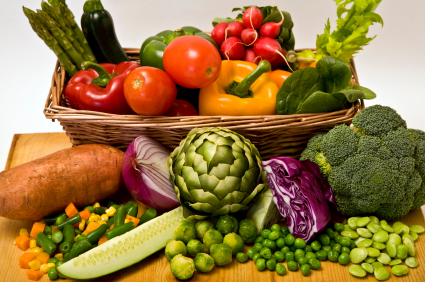
Choosing what to plant together for the happiest, healthiest garden is called “companion planting.” Companion planting is the practice of growing plants next to each other for mutual benefit.
This can happen because a companion attracts beneficial or repels harmful insects, or because the natural chemicals found in or produced by a plant improve flavor or growth.
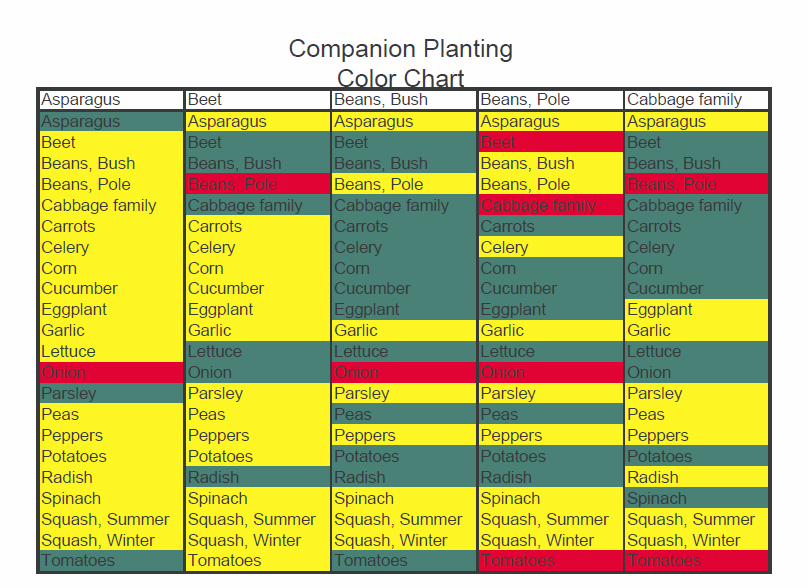
I have scoured the web for lists of what each vegetable likes and dislikes, put it all into a color-coded chart, and here you go!
- Download the file here.
- Look in the top row for the vegetable you are interested in.
- The column of vegetables underneath is color coded.
- Red is bad, yellow is good, green is best
Try it out and let me know how it works for you!


That would be great!
Would you be ok if I linked to your site from mine?
Strawberries take up a lot of space and spread all over, so I don’t recommend planting them with anything. In fact, I don’t recommend planting them in raised beds–I think they are great for a flower bed or as ground cover.
Hi,
What can I plant with strawberry’s? I did not see that on the list. Thanks
Just FYI, this works perfectly in Open Office Spreadsheet! You don’t need Excel : )
Thank you so much for this awesome tool! I’m new to all of this and this will help alot.
I’m getting ready to jump into square foot gardening and found your site while doing some research. The tools you’ve shared are awesome. Thanks so much!
This will be very helpful to me. This is my first attempt at square foot gardening. Your site is just a wealth of information. I am just waiting for the bumper crop of snow to melt so I can get busy building my garden.
This has been a HUGE help – thank you!
Stacy
I love your tables, I am starting a garden and I found them very helpful. I will post a link on my blog to your website. thanks for sharing the table!
thanks for the spreadsheet file! this will make my garden planning a breeze! this one plus the one I found at this site http://organic.kysu.edu/CompanionSpacing.shtml
will be sure to help grow a wonderful garden for my family! Thanks a mill!
Oh WOW- Thank you so very much for being so organized! I LOVE this site!
It is better to email me a spreadsheet of your layout mysquarefootgarden @ gmail. com (take out spaces). However, I’m pretty busy and haven’t been able to give a lot of feedback on layouts lately. Sorry about that (to you and everyone else who sent them in). I’m going to find a way to be more organized about that next year. 🙂
well, it didn’t work. if you know how i can post my layout please let me know. thanks so much.
LOVE your site!!!
i was wondering if you would dive me your opinion on my garden layout. i have tried to copy it but i’m not sure how it will show up. sorry
4′ X 14′ 4′ X 14′
cucumber green beans lettuce cilantro marigold anaheim peppers bush tomato bell peppers big jim bell peppers onions tomatillo
jetstar tomatoes marigolds marigolds tomatillo marigolds
cherry tomatoes marigolds tomatillo
carrots lettuce jalepenos oregano basil big jim onions marigolds onions
sunflowers chives
squash marigolds broccoli
okra 4′ X 6′ 4′ X 6′
pumpkin carrots beets sweet potatoes raspberries blackberries blueberries
sunflowers watermelon lettuce
chives marigolds marigolds
corn lettuce potatoes strawberries
carrots
Hello Emily,
Thank you for all this wonderful information!
Its my second gardenings year this year.
I am a organics gardener and your info is
the best i can get this moment.
wish you Happy gardening
This is amazing!! I have found so much value from your wonderful website, please keep up the good work!!
Thanks so much! I found your site last year and it helped me a ton. This year I know a little bit more and your site is helping me even more.
Thank you those charts are great!
Thank you so much for sharing your hard work.
Thank you! I am doing my first garden and your website rocks!
Wow! Thanks so much for sharing your hard work. This is awesome. I’m planting my first and a bit overwhelmed. Your site is incredibly helpful! I had no problems with the files on a Mac. Many thanks again!
Well done! Great asset to us newbies. Thans for all the hard work and organization.
I am planning to make a deluxe version when I have time to research more companion planting. Probably I’ll leave this version for this year, and in the winter when I have time I’ll update it.
Emily this chart is great! I was able to open it without any difficulties. If you could add the followings it would be even more fantastic 🙂
fennel, rhubarb, strawberries, artichoke, leeks, all the aromatic herbs (or parsley represents all of them?), melon (cantaloup), swiss chard (or is it the same as a vegetable available in your excell sheet?).
Thanks again for all your effforts to make our vegetable gardens look awesome!
Ok, so now I know why my pole beans didn’t do so well last year. I had them in with tomatoes!
Thank you for the help.
Didn’t mean to be tricky–Broccoli is part of the cabbage family. So the cabbage family includes broccoli, cauliflower, and cabbage.
I LOVE this tool! I’m only wondering why broccoli isn’t on the list??
Looks like a cool idea, but there are no drop downs for me in Pages ’09. I like your “bad, good, better, best” categories, I’ve never found anything where they defined it like that. I just have a basic companion chart on our site as a resource for the users of our online garden & farm planning software (the Fantastic Farm & Garden Calculator).
Your site is a nice resource! Glad to see so many people into growing their own food!
Jim
Wow! I this is an awesome tool! I just found your site and can’t thank you enough for this helpful info! Hubby and I are just getting ready to start our garden for the year, so hopefully this will help us be successful this year. (We haven’t had much luck in past years). Thanks again!
Emily,
Thanks for the Companion Planting guide! It has been extraordinarily helpful in planning my garden. This is a fantastic excel sheet. You should get this patented.
Richard
Thank you!! You are AWESOME!!
I have updated the post with new versions and instructions. Hopefully this helps! Emily
I still can not open the document. Is there any way you can copy and paste and email it to me?
Thank YOU!!
I’m so excited I found your sight!!! This looks like it would be great. Although I’m having trouble accessing the color and drop down menu versions. When I click the picture link I only open the number chart in excel. I’m probably totally doing something wrong or completely over looking the obvious, but would appreciate any help. I would really like to use the other versions!! Thank you for your work this site is awesome!!
Wow, this is very helpful! I love techno-gadgets like this one. 🙂 Although I won’t be using it much with my itsy bitsy 1×6 garden, but oh well, I can dream of bigger things in the future! 😉
I have open office and was able to convert to that, when I tried to convert to pdf the first page with the drop down menu is non workable. However, the color chart is awesome as is the numbers page. Emily if you would like me to I can email you the Open Office version as well as try to get the color version and number page in pdf format and send those to you as well, just let me know!!! Thanks a bunch I just did my layout and an online planter at another place that allows for SFG and realized I may need to re-arrange a few things, like to may root crops next to each other……. This is an awesome sheet thanks a bunch, I’m gonna post about it and link back to your page so anyone who happens across my blog can come get it.
How about melons? Not sure what to plant cantaloup near.
I updated the spreadsheet today so it has 3 worksheets, the first is dynamic, the other two can be used if that won’t work.
–Emily
This chart doesn’t consider anything except whether it’s helpful or harmful from a disease/pest/growth point of view. For example, I’ve found I don’t like to plant two kinds of root vegetables next to each other because they compete too much for space. Or, like you said, a vegetable shade the other too much.
I downloaded it and it works just fine. At first I thought it was broken, but then I read your comment about the drop down lists – i didn’t know they were there and it wasn’t readily apparent to me. Thanks, though, this is great work!
I do have a question, though. I used peas and tomatoes as my combination plants, and it suggested I put radishes in between. Wouldn’t they shade the radishes too much? They’re so big, and radishes are so small…
Thanks for this guide. There is a book called carrots love tomatoes that is good as well.
I can sure try exporting it to several formats to see if that is helpful. The colors and numbers tabs are full of hidden data I used to create the form. They should be blank to you.
The form should have drop down lists that you select and it automatically updates the lists. Perhaps that functionality didn’t come through. Let me work on another version (perhaps without the protection).
Okay–has anyone been successful in downloading and using this spreadsheet? If it’s unusable to everyone I’ll have to reconfigure it. I am not aware of any way to make this an adobe document, since it has formulas in it. I can put out the chart I used to create this. But I warn you, the chart is not so easy to use!
OMGSH!! I have so been researching this topic!! Thank YOU!! I can not get the document, is there any way you can send it to me in an ADOBE document?
Kristin ~ Yes, it is. At least if you’re using Numbers. I had the same problem. I think it’s because she used password protection to protect certain cells (because she has formulas going in the background that we don’t need to be fussed about). But Numbers doesn’t import that. I had a friend open it in OpenOffice, resave it, and email it to me and it opened just fine. Roundabout, sure. But it worked. [shrug]
Emily ~ Was there supposed to be something on the Colors or Numbers tabs? And am I reading this wrong, or is this only telling me what I should plant by my spinach and between my beets and beans? Were there supposed to be other veggies, too?
Thank you for all this wonderful information! I am staritng my first SFG and stumbled across your site when I googled looking for pictures and other information.
Again…. thank you!!!
I downloaded it and tried to open it, but it said it was encrypted. You could try publishing it as a google doc, then you could update it whenever!
when I tried to open the doc, it said it was encrypted. is this because I’m on a Mac? bummer.
Oh my goodness, thank you! This is exactly what I’ve been looking for! All the charts on the web are so messy; this makes it so easy.
(In the future, I’d like to know the “bad” plants too. Just my curiousity.)