
Square Foot Gardening Soil
How to Create Mel’s Mix

You may be asking “whose mix”? Mel Bartholemew is the author of All New Square Foot Gardening and the founder of the square foot gardening method. He recommends filling your garden boxes with a special mix, instead of dirt. Here’s the mix, how much it cost, and the benefits:
Mel’s Mix
- 1/3 vermiculite
- 1/3 peat moss
- 1/3 compost (from as many sources as possible)
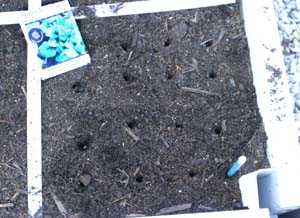
This is done by volume. My garden beds were each 4’x4′ and needed 6″ of mix to fill them. 4x4x.5=8 cubic feet of Mel’s mix. I did three boxes, so I needed 24 cubic feet of mix, 8 cubic feet of each item. Now, this amount did fill my boxes initially, but as I watered and the mix settled, I added more compost.
The Cost
I was able to buy the peat moss and compost at WalMart or Home Depot, but I only found the vermiculite at IFA Country Stores (Intermountain Farmers Association).
- 2 large bags (3.5 cu ft) vermiculite, $18.00 each
- 1 large bale (3.8 cu ft compressed, expands to be more) peat moss, $9.00
- 8 bags (1 cu ft) compost, $2.00 each (average price)
- 6 extra bags (1 cu ft) compost, $2.00 each (average price)
- TOTAL COST (three 4’x4′ boxes): $73.00
The Benefits
Why not just use dirt? You can, but there are some great benefits to Mel’s mix:
- Planting and germination–Mel’s mix is much lighter than dirt, and it doesn’t get compacted down because you never walk on it. This allows seeds to push through much easier, so you don’t have to be so particular about what depth you plant the seeds.
- Root systems–It’s really easy for roots to grow and spread in Mel’s mix. I was surprised when I pulled up my lettuce plants, the root ball was so large, nearly the whole square came up with it. I just shook out the mix and composted the old plants.
- Weeds–by this I mean, WHAT WEEDS! As long as you are careful with what compost you get, there are no weed seeds in your mix (unlike dirt). If a seed blows in, the mix is so loose it’s easy to tug them right out. Again, I spent less than 1% of my time in the garden weeding. As a side note, I made the mistake of buying Nutrimulch (turkey droppings), and had tons of bugs. I won’t do that again!
- Drainage–with Mel’s mix, you cannot overwater! Mel recommends hand watering, but if you choose to irrigate, how do you get the right amount of water to each plant? Easy! I used a drip system, and watered away! Mel’s mix drains so well, you don’t have to worry about it.
When you use Mel’s mix, you don’t have to worry about what kind of soil you have, or amending the soil. Every time you plant a square, you add a trowel of compost. You don’t have to rotate where crops are planted, or do anything special, unless you want to.
Cost Savers
Mel’s mix can be more expensive, but there are several ways to cut costs.
- BULK COMPOST–First, I bought compost in bags, but you can go to your local recycling center and get a truckload for about $30.00. Depending on how many garden beds you have, this could really save you. Here are some compost sources in Utah.
- PLAIN COMPOST–Also, you can fill your boxes with straight compost. The only drawback to this is drainage–your plants can really get waterlogged if you don’t pay attention.
- MY MIX (MODIFIED MEL’S MIX)–1/4 peat moss, 1/4 vermiculite, and 1/2 compost mixed in the box.
In fact, this year I am doubling my boxes (building 3 more) and doubling my boxes (making them twice as high). For my existing garden beds, I will just add more compost. For the new beds, I will use my alternate version of Mel’s mix.
Mixing It Up–Tarp Method
Mel recommends mixing this on a tarp–so that’s the method I tried at first. The biggest mistake was that I tried to mix 24 cu ft of material at once. It was so heavy I could not lift even a corner. I know others who have mixed it in a wheelbarrow, but I think this is too small a batch. It might work to combine 8 cu ft at a time.
- Pour compost on a large tarp. If you used several types, mix it following the instructions below before adding other materials.
- Add vermiculite.
- Add peat moss.
- If it’s really dry and dusty, mist it down but do not get it wet (makes it heavier).
- Mix by taking two corners of the tarp and pulling them over the tarp (like making a burrito) until all the material is close to one edge, lay the tarp flat. Then take the opposite two corners and pull the other direction, lay the tarp flat. Switch back to the other side and pull until all material is running down the middle of the tarp.
- Now shift 90 degrees (so you are looking down the column of material) and repeat. Basically, pull north, then south, then north until it’s in the middle. Then pull east, then west, then east until it’s in the middle again. Repeat until it is uniformly mixed.
Update
The second year, I “upgraded” by boxes from 6″ to 12″. This required more soil: 4x4x1=16 cubic feet. To keep costs down (especially for vermiculite) I created My Mix:
- 1/4 vermiculite
- 1/4 peat moss
- 1/2 compost
Here are the updated calculations: 16 cubic feet per 4×4 box
- 4 cubic feet of vermiculite $25
- 4 cubic feet of peat moss $11
- 8 cubic feet of compost $25-40
The other change I made is in the method of mixing. I didn’t like using the tarp method because I garden by myself, and it was cumbersome and heavy. Instead, I put some of each ingredient into the box, mix with a spading fork, and then add more. When it’s dry it mixes easily, you can almost “stir” it. After your’e done, soak it really good with your hose.
Go here for information on what to add to Mel’s Mix after the first year.


First, I would not recommend potting soil to fill your beds. Instead, use straight compost or a mix of compost, peat moss, and vermiculite.
I am thinking when you said “one square” you don’t mean one square foot, but one entire garden bed. Is that right? Corn needs to be planted in bulk so it will pollinate. I would say you probably need to plant at least 8 square feet to make it worth it. And you’ll want to provide support, because it can easily blow over in the loose soil. Corn needs plenty of nitrogen, so you will probably want to fertilize.
I have added additional vermiculite and peat moss, but I would say you can go 3-4 years (or more) without doing so. I add compost every year. However, I also use fertilizers and organic mixes to improve the soil as well.
I have been looking at your site for a time now and I am going to be doing my first SFG this yr. I have a plan that I will submit as soon as I can. Since I am going to be starting from the beginning with building all my boxes and all that I am looking to see if I can just use good potting soil, if so what would you say will work. I am going to be doing one square all of corn and would like to make sure that it is going to be ok in the soil that is in that square.
Hi Emily — I just discovered your site and it’s come in very handy as I start planning my first SFG. Question re. Mel’s Mix: I know that IN THEORY the only thing you have to add after building and planting your SFG is some compost after every harvest, to replace nutrients taken up by the plants. Does this theory hold up in practice, or have you also had to add fertilizers, lime, etc. over time? Thanks!
I buy mine at Wal-Mart, Home Depot, Lowes, IFA, etc.
Where were you able to find bags of compost in Utah? I don’t have a truck so the bulk compost won’t help any. Thanks. I love your site.
Corn roots don’t go very deep, so it’s not the depth of the soil that is important for support–it’s how well the soil holds together. So for example, clay soil is going to support the corn just fine, while sandy soil (or Mel’s Mix) is not. You may need horizontal supports for corn if using Mel’s Mix.
Mel,
How deep of soil do i need to grow corn? Seems like it should be deeper due to the height it gets and the support it would need from the root base to stay up. Loved your book.
Thanks,
Dick
Hi Emily,
I just found your site. I love it. I have been using my SFG for 3 years. In Louisiana, I can garden just about year round (though, at present we are expecting freezing weather day after tomorrow, but probably it’ll just last a few days). When I first started gardening, I began with Patricia Lanza’s Lasagna Gardening, then SqFt Gardening by M. B.. I’ve built a garden in my backyard (4’x8′) and one at the school where I work (4’x12). This spring I’m taking on a really big project with a space of 110′ x 110′. I am planning on using your “dog-eared fence pickets” planting box plans for planting beds in this space. I’ll be working with children, ages 8-14 at this huge space. I’m really looking forward to it. We will be checking out your site some more when we get started. I think you will be a good resource for me and the kids. Thanks again for the great site. Paula
Vermiculite is not toxic; the concern is that some sources of vermiculite might also contain asbestos, which is toxic. Where I live, you can buy it at Home Depot, or the local farmer’s co-op–IFA (Intermountain Farmers Association). I use it in my gardens, and it turns mucky, soggy soil into moist, well-drained soil. So, I love it.
You can try substituting with Perlite. If you are getting weeds in your garden, it’s not from the lack of vermiculite (though the lack will make it harder to pull the weeds). It means you have poor quality compost with weed seeds in it.
How much to water should be based on the soil moisture levels, not the heat. It might be helpful to mist your plants to keep them cool, or place your garden in a location that gets afternoon shade. You can create your own shade as well. I would suggest at least 10-12 inches of soil–I found that some of my plants were stunted by the heat. However, I have a friend whose gardens are surrounded by gravel and get very little shade. She has fantastic results with watermelon, squash, tomatoes, and peppers.
Be sure to sign up for my newsletter as a guide of when to plant. You’ll need to grow cool-weather crops early in the spring (almost winter time) and late in the fall.
I am getting ready to start my sfg. I live in phoenix AZ. Is there any special tricks (like watering every day) to do to combat the heat. Do I need more than 6-8 inches of soil because of the heat? Thxs John
I live in the Dallas Texas area and I didn’t get Mel’s Mix made for my garden because I keep hearing that you can’t buy Vermiculite from the garden centers. They keep saying it’s toxic and I should just use compost. Tried that and my garden just didn’t grow well – weeds flourished. Is there a good substitute for Vermiculite? Or good source locally?
Joe, I’m working on a post about tomato problems, and will address this there.
I have had kind of mixed results.Beets did very good,broc did good ,peppers did good.Beans we are getting a fair amount but leaves are yellow and anemic looking.Tomatoes have been a major dissappointment.leaves look like they are dying.very little fruit and they have black spots upon ripening.used about half compost with about a quarter each of peat and vermiculite.it was a compost that i got from landfill.any thoughts?
You can find vermiculite in the Seattle area at McClendon’s hardware. 3.5 cu ft bags are $28. Like to know if any other stores have it cheaper.
The mix is very loose, I have needed to tie up or stake any plant that grew over 18 inches tall.
I use 2 X 6 to 2 X12 lumber (free) to make my beds. I use pure compost until it gets 6 inches from the top then use mel’s mix. to fill it up the rest of the way.
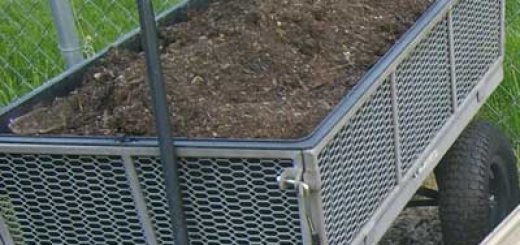
I gave up on the tarp mixing method. I use a 5 gal bucket to measure each ingredient and dump it into a wagon. After mixing I pull the wagon to where I need it and dump it.
It may take a bit longer but my back feels better not bending down or pulling heavy weights. And all my bulk ingredients can stay in one place.
Hi Emily,
This looks like a great site and I’m sure I’ll be referring to it regularly as I begin my SFG. I’ve gardened a little in the past w/ varying success and am really looking forward to SFG. Regarding Mel’s Mix, while I will look into getting better prices for the ingredients, I’ll probably be doing a planters mix that I can buy $35.00 a yard as that will probably be most cost effective. It doesn’t have any vermaculite or perlite, but bark chips to retain moisture. Have you heard of this? I’d like to add vermiculite or perlite but it’s just so expensive. However, I am planning to add additional compost. I know I’m supposed to add several different varieties – is cow manure compost, organic compost & grass/leaf compost appropriate? I know Mel’s Mixture is best and in the future I’d like to alter what I’m doing but now I’m trying to lower the initial cost. We’re planning on starting w/ 3×7, 4×5, 4×5 & 4×6 boxes due to space constraints – trying to fit them into a side planter bed! Thanks!
Anne–thanks for your concern. I’m guessing that what you saw is a google ad. Since my site is about gardening, google puts topic-specific ads in that space. I’m not promoting round-up, though I will admit that I’ve had occasion to use it. My first step is always organic, but when that fails (and sometimes it does), I will resort to chemical means.
Anyone in the Davis County area –
Rockin E Country Store in Woods Cross has everything for the garden mix.
They are located at 1201 W 500 S – Woods Cross.
They also grow the vegetable starts on site.
Vermiculite 4 C F- $23.99
Peat Moss 3.8 cu ft – $12.99
Compost starting @ $4.99 (several kinds)
Prices as of June 12, 2010
Just thought I would pass on that information.
PS – Great site with great info.
I noticed at the top of your website that you are recommending use of Roundup. It is a known poison — toxic to people and the planet.
Nita–it sounds to me that the weeds may have blown in, but more likely the compost you used had weed seeds in them. Another possibility (I don’t know where you live) would be that the weeds came in with irrigation water. Now, if you water with culinary water then that is ruled out.
You really don’t want to treat the weeds with any chemicals because it could impact the plants you are trying to grow. My best guess is that you want to keep weeding until they’re gone. Eventually, all those weeds will have sprouted and will be gone forever. Just be particularly careful when you buy compost to get “weed-free” compost. If the animals feed in a field of weeds, that gets passed on to you, unfortunately.
Hi. Maybe you can help me. I have the sfg book and follow the instructions for making mels mix. I planted my garden and the seedlings came up but so did a ton of weeds. I’m pulling 10-20 weeds out of my garden daily. I live in a very rural area and my yard + neighboring yards are covered in weeds. Do you think that the weed seeds were carried into my garden by the wind. I have weeds growing in squares that are not even plant yet. Is there anyway to stop this from happening?
Thank you so much for making this easy to find and follow! I’ve tried to refer to the square foot gardening site, but it is ridiculous to find information. I started this last year and had a blast with my kids, my daughter and I had so much fun digging up our potatoes and our peas never made it to the table because she would eat them straight from the garden…lol.
We have found reasonably priced vermiculite at pool supply stores and we got very large bags compared to the farm store.
Thanks again!
I’ve never heard of it or used it. I’d trust the opinion of someone at an Ag store or nursery. Wouldn’t trust a Wal-Mart employee (sorry, folks, you just don’t specialize in gardens), but I might trust a person from Home Depot. Anyone else used this?
Thank you so much. Is the dehydrated one safe to mix in too?
Okay–there is a difference between compost and manure. Manure is poop, plain and simple. Compost means it’s been mixed with stuff and allowed to decompose a bit. The process of composting should heat it to the point that it kills bad bacteria, weed seeds, etc. Read the label carefully–you are probably looking at chicken manure compost, shrimp manure compost, etc.
Avoid STEER manure–they fatten the cattle up by feeding them salt and hormones. But COW manure would be fine. To make Mel’s Mix you should combine as many types as possible, giving you a wide array of nutrients for your soil.
I live in NYC and when I try to buy compost I am confused with choices. Composted cow manure, dehydrated cow manure, garden manure from Home depot, chicken manure, shrimp manure. But no plain compost. Can I use any of these sources?
I do the opposite with my potatoes–pull the soil out and pile it up as the plant grows. I haven’t done anything special with cucumbers, and had a multitude last year. I think the roots do like a little shade, which mine had from some surrounding plants.
I am referring to your site a LOT as we begin our SFGs this year. It has answers for my many questions as I want to avoid the trial-and-error process.
Do you find you need to have additional mix handy to mound up around potatoes, cucumbers, etc?
Joe–12 inches is plenty for everything I’ve grown–tomatoes, carrots, potatoes, onions. . . I put a weed barrier in mine, but you don’t have to. It depends on what is growing next to it. If it’s next to grass, do the barrier. If it’s in a dirt patch or surrounded by concrete, you could skip it.
Thanx for the reply!
My beds are 12 in deep.Do you think thats deep enough or dig more out of bottom.Also with it being 12 in deep do you need a weed barrier in the bottom?
Thanx,Joe
If you are getting bulk compost I would dump in a wheel barrow of that, add a bag of vermiculite and peat moss, and then mix it with a pitch fork or your hands. Repeat. You can try tilling it in–it’s just like what I do every year when I add compost. It’s back breaking to do by hand (my back is still hurting) But I worry that power tools or equipment would damage my beds.
All I know about gardening in straight compost is that people do it, and have great gardens. I much prefer to add the peat moss and vermiculite–I think the soil drains better and is easier to work with.
Hi, I built my my beds 4 x 12 x 12 in .Now I’m ready for the dirt.Do you think i could just fill 3/4 fiull with compost and till in vermiculite and peat from the top?I can get compost from the lanfill for about 15.00 a ton.Also the lady at the green house here said just using compost is not a good idea,too hot?Thanx,Joe
Thanks so much Emily! I really appreciate your time!
It’s helpful if you put down a weed barrier of sorts. Weed mat is great, though some have used newspapers (in thick sections).
My Square Foot Gardening book is in Storage and I’m needing to start my garden but I can’t remember if I’m suppose to put something down before the Mel’s Mix…….. Could someone help me know what I need to do before I put all the Mix in. We have moved and I won’t be able to get to the book in time to get my garden started. The Library will take forever to barrow the book during this time of year. Help Please!
Michelle–I’m sure medium vermiculite will be fine. The thing you want to watch for is size–did you get a huge 3 or 4 cubic foot bag? If not, you’re going to pay double for it and you won’t have the bulk you need to really make a difference.
Hello– I just bought the stuff to make Mels Mix. The only vermiculite I have found is medium not course. Do you think this will be o.k.?
Hey Emily,
Thanks for the advice. I just did the 1/3 mix in my bed. It’s so light and airy, but I’m thinking I’m going to mix in more compost now to get the 25%/25%/50% alternative you recommended. That way I don’t have to add more during the season and can still get the depth I want — I’m doing a little deeper — 9″ so I can do some carrots and turnips.
I use a tarp to make Mel’s Mix all by myself! The trick is to do only 3 cubic feet at once (well, maybe 4). And I’m in my 60s.
I found coarse vermiculite in the Los Angeles, San Gabriel Valley area at WHITTIER FERTILIZER CO, 9441 Kurse Road, Pico Rivera, CA 90660 (562) 699-3461. $18 also peat moss $17.50 and LOTS of compost and such
I visited my old( I mean very Old) church and their were just a handful of people there. I volunteered for the VBS..only 3 children in the group..but that evolved into 12 for the class. I suggested Mel’s sfg and the pastor was in agreement..So here I am, not a Gardner but an artist with beautiful pictures of veggies,flowers and salsa bringing this community together.Bringing children and old folks to an event that promotes growth in the community.I found You and Your site and look forward to all the help I can get. I was the corporate Facilities Artist that traveled to Park City Utah to paint their indoor parking levels ..so gardners pray for me and this venture. Pati Mills Winter Haven,Florida
I am trying to avoid buying peat moss because of environmental reasons (shipped from far away, for example). What else can I use if I want to try Mel’s mix?
What I did was potting soil and compost mixed together for two beds. For another bed, I’m using dug up sod on the bottom (my soil isn’t bad, so I don’t mind if the roots grow down into it), mixed with some potting soil and compost. I haven’t planted in this yet, so no idea how it will do. The potting soil and compost mix is working well, but doens’t seem very frugal. 🙂
I think that mixing my own soil with some compost is going to be the most frugal thing, but maybe not the most fertile soil, at least for this season.
For those in the Salt Lake City area, I found my coarse Vermiculite at:
Steve Regan Co.
Sells coarse Vermiculite in 3-1/2 cu foot bags
for $20@bag
801-268-4500
4215 S 500 W
Salt Lake City
They gave me a discount without me asking….$17.50 a bag.
That was nice.
Maybe they will give a discount to you, also.
George
Alan,
I had several reasons for “upsizing.” First, I wanted to grow some root vegetables, like carrots and potatoes. With my double-rail gardens, I had great success!
Second, I didn’t want to mow around my gardens, so I dug out the sod and covered the ground with weed mat, then gravel. the gravel gets REALLY hot, and I think the heat was stunting the growth.
Finally, I find that as the season progresses the Mel’s mix compacts down and sort of sinks. I wanted to be sure I had a MINIMUM of 6″ of soil–that was hard to do when the maximum that fit was 6″.
I just built garden boxes for a friend (watch for the post coming soon!) and used 2×10 boards. It was significantly cheaper than vinyl and I think 9-10″ of soil will work well for her.
Megan,
You can use perlite instead of vermiculite. It’s not the same, but if cost or availability is an issue, use the perlite. I just built garden boxes for my friend, and we used perlite to keep the cost low. Use in the same proportions you would vermiculite.
Just a note–since my boxes are extra tall (12″ instead of 6″), I have modified my Mel’s mix to be 25% vermiculite, 25% peat moss, and 50% compost. I find it’s enough vermiculite and peat to retain water and make the mix light and friable, but it keeps the cost down.
Emily,
Love your site. You mention in your Blog on How to Create Mel’s Mix that you plan on doubling the number of boxes and making them twice as high (12 inches vs. 6 inches) I was wondering why you wanted more depth. I am just starting out and interested in all things SFG.
Thanks.
I love your site! I’ve found it very helpful, and have already referred to it often. We’ve been trying to locate vermicullite in the Seattle area & are having a hard time. One garden store said we should be able to substitute perlite for it. Would the measurements/amounts work the same?
Thanks for sharing your experience!
The mix I use for growing under lights, is 1/3 each of peat, perlite, vermiculite. With the cost of all these going way up, I’m switching to about 1/2 peat and perlite, with a little virmiculite spread over the top of each planting to retain the moisture.
Be extremely careful when adding peat into Utah soil, that is clay.
Peat is extremely fine. It will bind with the clay and cause it to become harder. Which is exactly what you don’t want.
Also, don’t mix sand* into clay soil. When the summer heat comes, you will have turned your garden soil into adobe.
The best thing to do is add compost & lots of it. Avoid manures because of the salts.
*Sand actually can be mixed with the clay. Clay really holds water and is quite good with nutrients but they get locked up and the clay, as you know gets very hard in the summer. Sand is great to break up clay, but you will have to use more sand that you can imagine. A mix of 10:1 by volume is not out of the question. So for every pot of garden soil, if you mix in 10 pots of sand, it will make the clay friable. If you want to do that much work, okay, other wise, if you have clay soil, stay away from both peat and sand, as soil amendments.
I started with two 4×10 beds which are 12 inches deep. Filling with Mel’s Mix would have cost me a fortune! I did the truckload of compost method last year and had good success with my plants. I think the only downside was the watering issues. It was hard to know if I was getting the right amount of water. (I used a soaker hose which was kind of hard in itself). Anyway, this year I bought a few bags of peat moss and vermiculite and threw them into the garden beds along with some additional compost to fill the beds back up to the top. Once in the beds I mixed it all together with a rake. I’d say about the top half (6 inches) is comparable to your “alternative mix”. If the plants happen to develop deeper roots they will be stuck with plain old compost 😉 I’ll keep you updated on how it turns out this year!